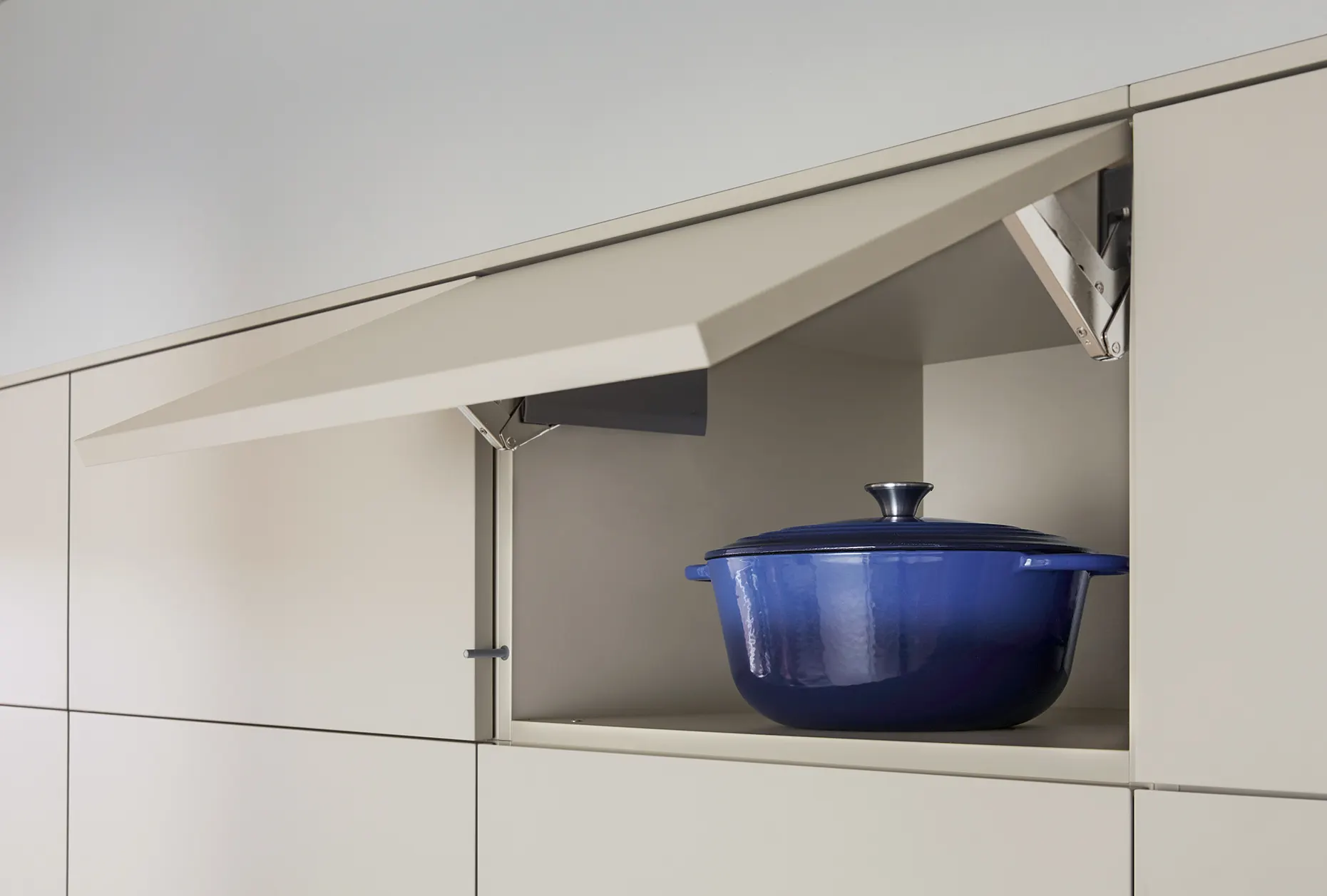

Choose white kitchen cabinets by picking the door style and the white together. Decide whether a cool or creamy tone suits your daylight, floor and worktop, then judge physical samples in your own room. Screens change white, so compare a real door sample in morning and evening light before you decide.
Key facts
- Schüller's Colour Concept includes 29 lacquer colours, including crystal white, white, magnolia and seashell white.
- Those four Schüller whites are available in matt velvet, satin or satin with pore.
- Matt surfaces such as Matera have AFP anti-fingerprint properties.
- Whites rarely match across ranges, so keep the kitchen, utility room, wardrobes and home office in one range.
- White makes edges and door gaps easier to see, so inspect a door close up before choosing.
How do you choose between a cool and creamy white?
Choose the undertone with your room, not in isolation. Cool whites look crisp, while creamy or stone-leaning whites can feel softer, but daylight, flooring and the worktop change how either appears.
Hold door samples against your wall, floor and worktop. Check them in morning and evening light, particularly if the room is north-facing or narrow. A screen or printed photograph can change the appearance of white, so a physical sample is the dependable reference.
Why does the door style matter more than the white?
The same white can look very different on a flat handleless front, a framed shaker door or a glossy panel. Compare the colour and the construction together rather than choosing a shade from a small swatch.
| Door style | What it changes | What to check |
|---|---|---|
| Flat handleless | Creates a simple, uninterrupted look and avoids visible handles. | Inspect the edge detail and door gaps closely. |
| Framed shaker | Adds a frame that affects the way light falls across the white. | Look at the frame, joints and shadow lines on a real door. |
| Glossy panel | Reflects more light and makes the white appear brighter. | View it from different angles in the room's natural light. |
MODENHAUS Kitchens & Interiors designs white kitchens in Schüller, next125 and Impuls, and its current white and off-white finishes can be seen at the studio. You can explore the studio's white cabinet options before comparing door styles.
Which whites and finishes can you choose from a German range?
A German range may offer several whites rather than one universal white. Schüller's Colour Concept includes crystal white, white, magnolia and seashell white, each in matt velvet, satin or satin with pore.
That gives you two choices to make together: the white and the lacquer finish. Schüller describes its matt velvet lacquer as velvety soft, and its satin-with-pore lacquer has a wood-pore structure. It also lists matt surfaces such as Matera with AFP (anti-fingerprint) properties (Schüller fronts).
Whites rarely match across different ranges, even when they look alike in a photograph, so keeping the kitchen, utility room and wardrobes in one range helps the cabinetry read as one scheme. The carcase, the cabinet box behind the door, matters too where its sides show: Schüller says 13 of its 29 colours are available for carcase exteriors (Schüller, September 2026), so ask which carcase colour sits with your white front.
Are white kitchen units difficult to live with?
White is practical when you choose its finish around how you use the kitchen. Pale surfaces show spills sooner, while matt surfaces tend to hide fingerprints better and gloss reflects more light.
Edges and door gaps also show more clearly in white. Ask to see a door close up, including its edges and the junctions between doors. Consider how often you cook and where hands usually touch the cabinetry. For a closer look at matt and gloss care and appearance, read the guide to handleless cabinetry finishes.
How can you stop a white kitchen looking flat or cold?
Use contrast, texture and warm lighting around the white. A worktop with soft veining, timber accents and warm light under wall units can give the scheme depth without losing its brightness.
Four ways to add warmth and movement
- Choose stone with some movement or soft veining rather than an entirely uniform surface.
- Add oak or walnut to introduce natural warmth.
- Use warm under-cabinet lighting so the room feels less cold in the evening.
- Select handles that support the scheme: black gives crisp contrast, brushed steel stays neutral and brass adds warmth.
Handleless cabinetry removes the need for visible hardware. If you choose handles, compare them beside the actual door sample, not separately.
Why should white be chosen from a full-size door?
White is not one fixed colour, and it does not look identical on every cabinet construction. The range, door profile, finish, carcase and surrounding materials all affect the result.
This is why a sample-led process matters. Compare the front at full size, inspect its edge and gaps, and view it beside the planned worktop and floor. Then check whether the same range can continue into the utility room and wardrobes. MODENHAUS can lay the options side by side at its Ruislip showroom.
Frequently asked questions
How do I choose the right white for my kitchen?
Compare cool and creamy whites against your wall, floor and worktop in the actual room. Check them in morning and evening light, because daylight changes how white appears. Review the colour on the intended door style as well: a flat handleless front, framed shaker door and glossy panel can make the same white look different. Use a physical sample rather than a screen.
Is matt or gloss better for white kitchen cabinets?
Matt and gloss suit different priorities. Matt looks softer and tends to hide fingerprints better, while gloss reflects more light and appears brighter. Neither should be chosen separately from the door style, room lighting and how you cook. Compare both finishes on real doors, then consider the visibility of edges, gaps and everyday marks in your kitchen.
Are white kitchens hard to keep clean?
White kitchens are not automatically difficult to live with, but pale surfaces show spills sooner. Matt finishes tend to hide fingerprints better, while edges and door gaps can be easier to see in white. Choose a finish around your cooking habits and inspect the door close up. A suitable cleaning routine should follow the cabinetry manufacturer's care guidance.
Does white suit a small or north-facing room?
White reflects daylight and can help a narrow or north-facing room feel brighter. The undertone still matters: compare cool and creamy samples with your floor and worktop, rather than assuming every white will feel the same. Warm lighting beneath wall units, oak or walnut, and a worktop with soft veining can add depth and warmth after dark.
Can my utility room and wardrobes match my kitchen?
They can be planned as a coordinated scheme when you keep the cabinetry within one range. Whites rarely match exactly across different ranges, so using one range for the kitchen, utility room and wardrobes avoids a noticeable mismatch. Check the actual front, finish and carcase together, then confirm that the chosen range covers each room you want to connect.
Next, compare physical white fronts and discuss the door, finish and room plan at the MODENHAUS showroom in Ruislip, starting with the white kitchen collection.